Why Wearable Data Should Be Compared With Personal Baselines First
This article explains why personal baselines and person-level splits matter in wearable data. It describes SynapBridge Life's synthetic/local evaluation design and its limits around data leakage, false alarms, and probability calibration. Real-child performance, clinical meaning, and support-timing benefit remain NOT VERIFIED.
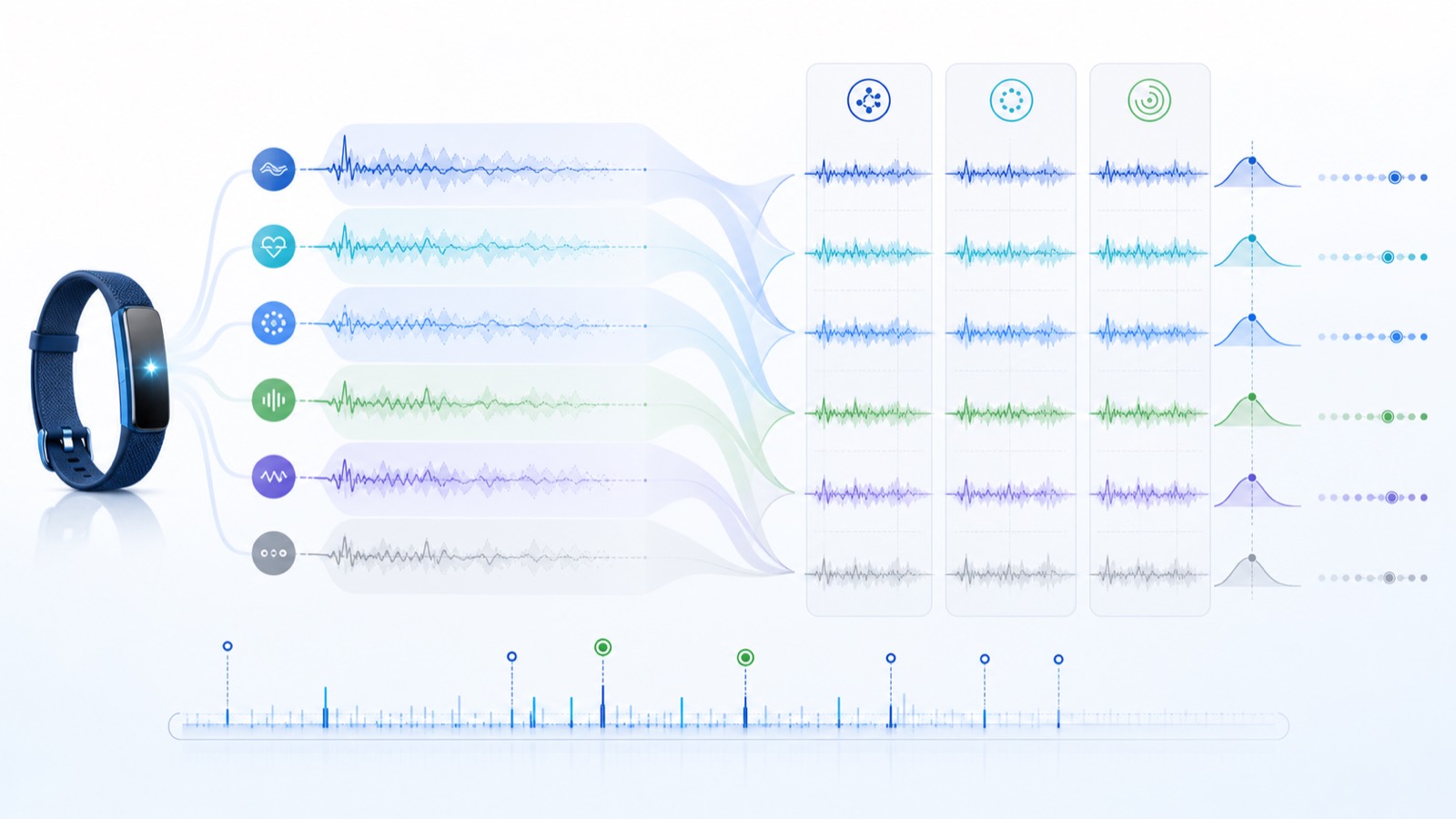
Wearable data accumulates repeated measurements over time. When the numbers grow, it is easy to think of complex models right away. But before choosing a model, we need to check whether the same number has the same meaning for everyone.
People can have different usual ranges for physiological signals. Even for the same person, the usual range can vary with sleep and activity. That is why some approaches compare a current value with that person’s past range rather than comparing raw values as they are. A personal baseline here is not a diagnostic criterion. It is closer to a computational starting point for comparing past records with current values.
How the data is split is also part of the model
In wearable research, one person can produce many records. If records are randomly split at the record level, the same person’s data may enter both training and evaluation. The model may then rely on that person’s distinctive features rather than a general pattern. Research addressing the problem of person-level information being mixed between training and evaluation points to the need for person-level splits.
A person-level split evaluates people the model did not see during training. To check whether the same standard applies to someone new, one person’s records must not enter both training and evaluation.
Derived variables organize raw signals as model inputs
In SynapBridge Life’s current local experiments, values such as the average, variation, and slope over a fixed time window are organized as derived variables. This makes it possible to compare linear models and nonlinear tree-based models under the same conditions while checking which inputs were used.
Derived variables that use only past information are created from synthetic time series, and training, validation, and final evaluation are split by person. This structure is not evidence that the behavior of real children was predicted. It is an experimental structure that makes it possible to check again what information entered the model and when.
What accuracy alone cannot tell us
Current local experiments are designed not to use simple accuracy alone when evaluating imbalanced synthetic labels. They also record the balance between precision and recall and event-level metrics. Wearable EEG research has also discussed that movement noise can greatly increase false alarms per hour.
Probability calibration examines how closely the probabilities produced by a model match the frequencies observed in evaluation data. A calibrated probability does not confirm an individual’s state. It can, however, be used to compare and review different candidates on the same basis.
The screen we want to build first
Rather than explain this only in text, it would be useful to have a tool that shows personal baselines, data splits, and false alarms on one screen. The tool should show which time window a raw signal passed through to become a derived variable, and whether the same person’s data crossed the evaluation boundary. It should record false alarms and uncertainty alongside the model score, rather than showing only the score.
The purpose of the current stage is not to promote higher performance numbers. It is to compare small models first, check for data leakage and evaluation illusions, and record what must be revalidated when real data arrives. Performance on real children’s data, clinical meaning, and whether this helps earlier support remain NOT VERIFIED.
This article explains synthetic data and local evaluation design. It does not provide diagnosis or medical advice.
Frequently asked questions
Is a personal baseline a diagnostic criterion?
No. The personal baseline described here is a computational reference for comparing past records with a current value. It is not a criterion for diagnosis or for confirming an individual’s state.
Why is a person-level split needed?
If records from the same person enter both training and evaluation, a model may rely on person-specific features. To evaluate a person not seen during training, the person-level boundary must be maintained.
Can a model with a high score be used right away?
No. In addition to a simple score, false alarms, probability calibration, person-to-person differences, and revalidation in real sensor environments are needed. The current results are limited to synthetic, local experiments, and real-child performance remains NOT VERIFIED.
Sources and connections in the text
- Person-level splits and data leakage: Scikit-learn GroupKFold, Identity confounding in digital health machine learning
- Personal physiological baselines: PhysioMTL
- Probability calibration and false alarms: Scikit-learn probability calibration, Wearable EEG artifact and false-alarm study