A Model That Reads the Flow of Time, Not Just One Moment: Handling Wearable Signals With a Causal TCN
This article explains how a causal TCN reads past windows to prevent future-information leakage in wearable time series. It also describes SynapBridge Life's synthetic/local evaluation design and the limits of real-world validation. Real-child performance, clinical meaning, and support-timing benefit remain NOT VERIFIED.
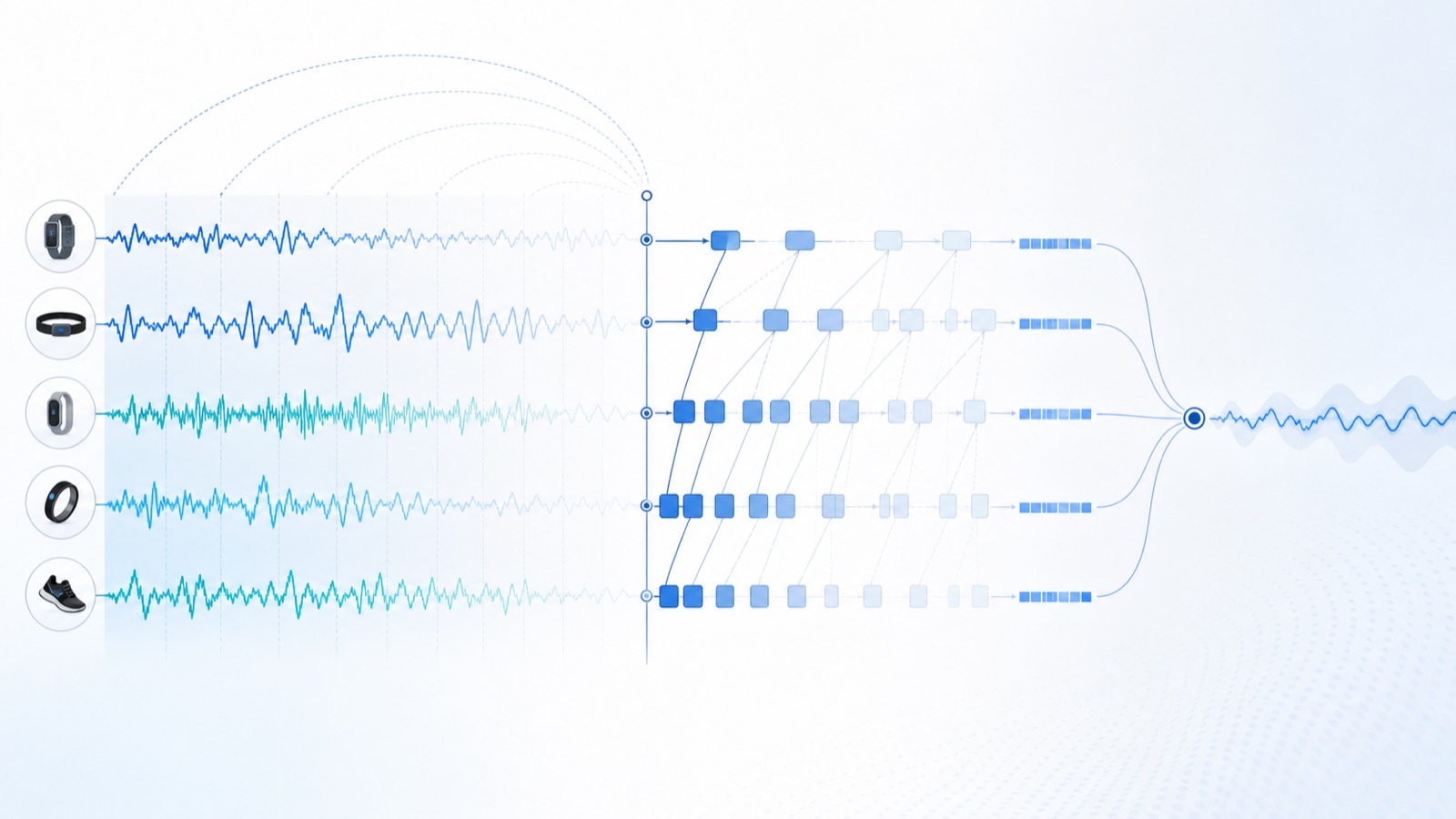
Looking at one moment of wearable data tells us only the value at that moment. The sequence in which movement begins to increase, signal quality worsens, and changes across sensors overlap is difficult to see from the value at a single moment. Deep-learning time-series models use inputs from multiple time points to handle this flow of time.
The important issue is not using a larger model. When results need to be produced in real time, we first need to decide which past the model can see and which future it cannot. If a current result also reads later data, information that was not available at that moment enters training. To prevent this, a real-time prediction window should end at the current moment and extend only backward into the past.
How does a causal TCN read the past?
TCN stands for Temporal Convolutional Network. It can apply causal convolution along the time axis so that future samples are not referenced. Dilated convolution looks at the past at regular intervals instead of reading only nearby points consecutively. This can widen the past context without greatly increasing the filter size.
Time series have more than TCNs. Recurrent models such as LSTM pass a previous state forward in sequence, while attention-based models assign weights to relationships between time points. Wearable activity-recognition research has also reported structures such as DeepConvLSTM, multiscale TCNs, and TCN combined with attention. No architecture can be called best in every case. Results can vary with data size, sensor types, sequence length, and evaluation method.
Why start with a small first candidate?
The current synthetic and local evaluation design uses a small TCN as its first deep-learning candidate. This is not because complex models are excluded. It is a starting point for distinguishing the causes of failure in a limited initial experiment.
The machine-learning candidate receives derived variables at one time, while the deep-learning candidate receives a continuous sequence ending at the same time. The dataset, person-level split, target, and evaluation metrics must remain the same. That is how we can distinguish a difference caused by the model representation from an illusion caused by different data splits.
Multiple outputs do not mean the model knows more precisely
A model can be designed to output several items together. But the fact that it has several outputs does not mean that it understands a real state more accurately. Each output needs its own review of label quality, evaluation metrics, false alarms, and uncertainty.
The stages and labels in synthetic data are reference labels created by generation rules. Learning these patterns alone does not establish that the model predicts the behavior of real children or helps with the timing of support.
A tool that shows failures first
The next screen we want to build should show the input boundary before the result numbers. It should mark the past segment used for a result and make it possible to check that future data was blocked. It should also record how much the result changes when one sensor is removed, and how false alarms change when time alignment is off.
The reason to use deep learning is not to choose a large model that is difficult to explain first. It is to examine flows of time that derived variables alone might miss and to see what difference appears under the same conditions as a simple machine-learning baseline. The current work is building the synthetic and local evaluation structure for that comparison. Real-child performance, clinical meaning, and any effect on earlier support remain NOT VERIFIED.
This article explains synthetic data and local evaluation design. It does not provide diagnosis or medical advice.
Frequently asked questions
Is every TCN causal?
No. Some TCN designs may use information from future time points. This article addresses a causal convolution design that blocks future samples when real-time results are assumed.
Is a TCN always better than LSTM or attention?
No. Results can vary with data size, sensor types, sequence length, and evaluation method. The models need to be compared using the same data and the same person-level split.
If it works on synthetic data, can it be used in a real environment?
No. Synthetic data can be used to check experimental structure and whether leakage is present, but it does not validate actual sensor noise, individual differences, or clinical meaning. Real-world performance remains NOT VERIFIED.
Sources and connections in the text
- Causal convolution and time order: Bai, Kolter, and Koltun, convolutional and recurrent sequence models, Lea et al., temporal convolution for sequence segmentation
- Alternative structures for wearable time series: DeepConvLSTM for wearable activity recognition, TCN-Attention-HAR, Multiscale TCN for user-independent activity recognition